-
-
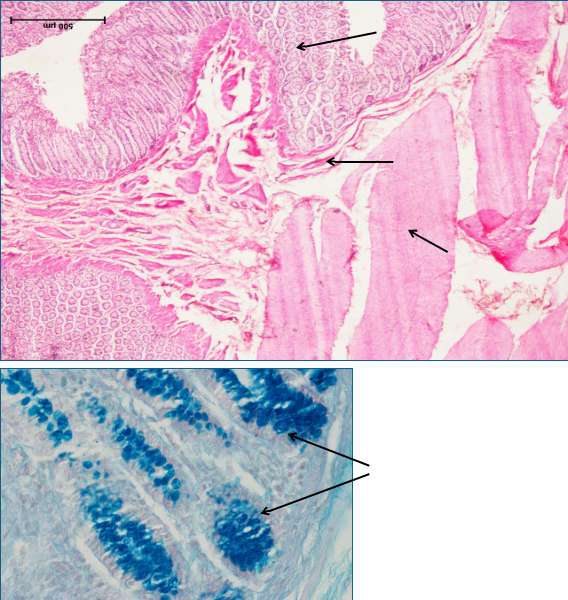
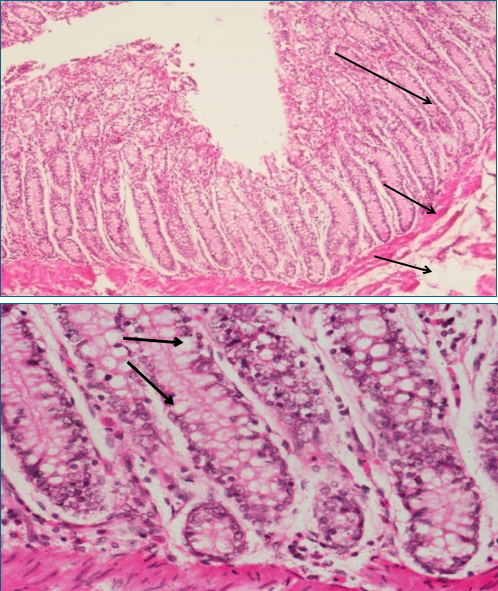
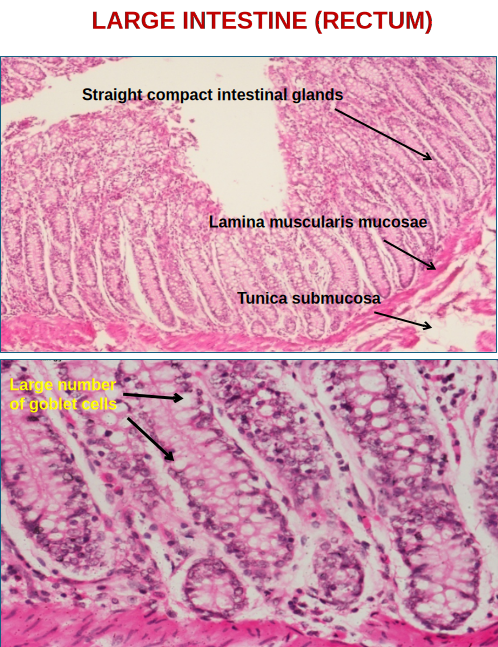
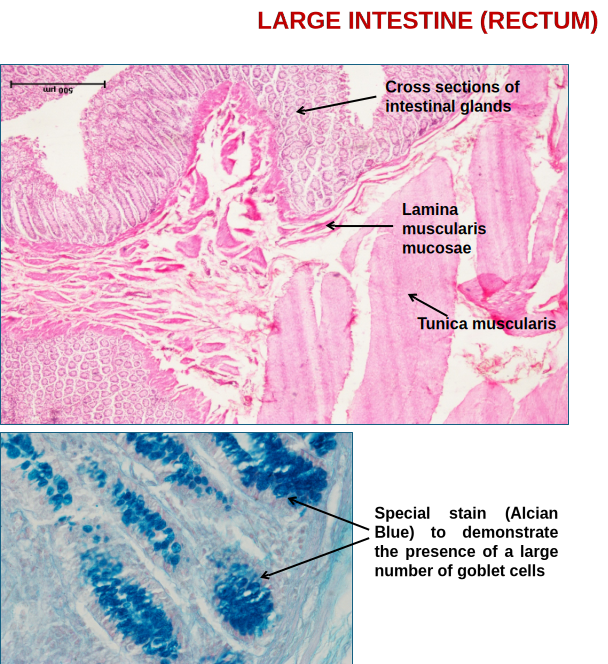 LARGE INTESTINEComprised of the caecum, colon, and rectum.Characters common to all segments of large intestine are:1. Absence of villi 2. Plicae circularis absent 3. Longer, straight compact intestinal glands 4. Goblet cells are more numerous 5. Paneth cells absent 6. More number of lymphatic nodulesCaecum: In nonruminant herbivores (horses), the caecum is well developed because it is the site of microbial digestion. Small in carnivores❖Lymphatic nodules at the beginning (Ileocecal opening) in ruminants, pigs, and dogs, and at the blind end in the horse.❖The outer longitudinal layer of the tunica muscularis forms flattened bundles or fascicles called the Taenia Ceci.Colon: Within an individual, the intestinal glands are longer than the caecum❖The outer longitudinal layer of the tunica muscularis forms Taenia coli in the pig and the horse.Rectum: A larger number of goblet cells are present❖More number of goblet cells are present❖Cranially, serosa and caudally, adventitia are present❖Close to the anorectal junction, the mucosa is thrown into longitudinal folds called rectal columns❖In dogs, about 100 solitary lymphatic nodules are present in the mucosa or submucosaAnal canal: Terminal segment and simple columnar epithelium of rectum changes abruptly from simple columnar epithelium to stratified squamous nonkeratinized epithelium. Anal canal has three zones in pigs and carnivores 1. Columnar zone 2. Intermediate zone 3. Cutaneous zone❖Modified tubuloalveolar sweat glands called anal glands are present in carnivores and pigs.❖Bilateral cutaneous diverticula, called anal sacs, are present in carnivores and open at the junction of the intermediate and cutaneous zones❖Circumanal glands (sebaceous glands) present in dogs in the cutaneous zone near the junction with the skin